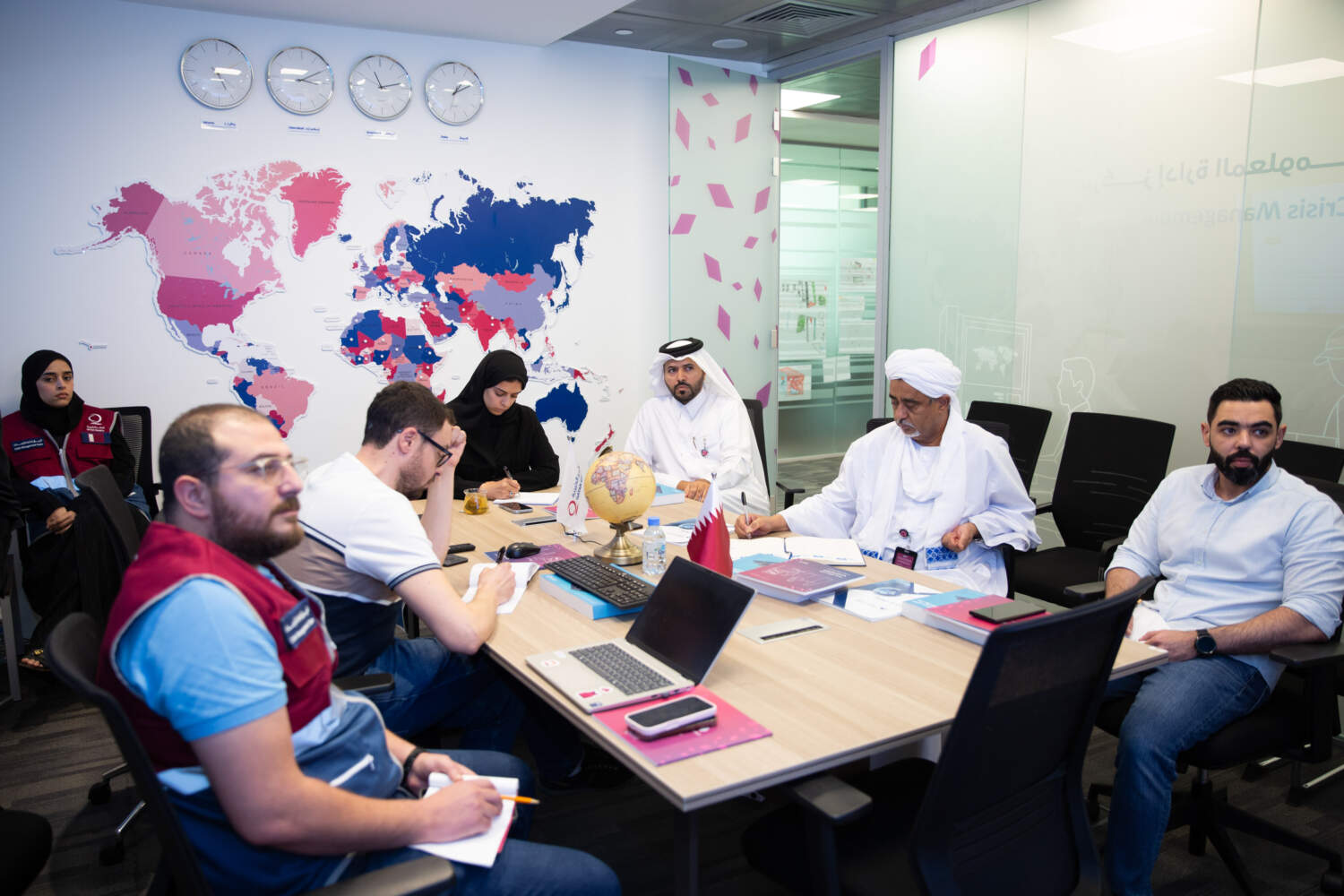
Overall, Qatar Charity’s Information and Crisis Management Centre, launched in June 2026, uses data and artificial intelligence to speed up humanitarian response.
Quick Facts About the Crisis Management Centre
- Launched in June 2026
- Monitors humanitarian crises worldwide around the clock
- Uses artificial intelligence and data analytics to inform decision-making
- Uses geographic information systems (GIS) to map needs and prioritize assistance
- Supports early warning and anticipatory action
- Tracked Qatar Charity’s response to severe flooding in Nepal in August and September 2026
- Supported the monitoring of assistance for newly arrived Yemeni refugees in Djibouti in September 2026
- Helps speed up response, strengthen planning and maximize humanitarian impact
- Is a flagship digital transformation project under Qatar Charity’s 2026-2030 Strategy
Moreover, as climate-related disasters and conflicts drive displacement and increase humanitarian needs, Qatar Charity has launched the Information and Crisis Management Centre to support faster, more evidence-based action. Established in June 2026, the Centre is a key component of the organization’s humanitarian digital transformation.
By bringing together data, advanced technology and artificial intelligence, the Centre aims to improve response times, strengthen planning and make relief operations more effective in areas affected by crises and disasters.
Why Did Qatar Charity Establish the Crisis Management Centre?
The Centre was established in response to a rapidly evolving global landscape, particularly:
- The growing number of climate-related disasters.
- Escalating conflicts and the resulting waves of displacement and forced migration.
- The need for real-time information to support decision-making.
- The importance of rapid intervention during the first hours of a crisis.
- The expanding role of technology and artificial intelligence in humanitarian action.
- The need to strengthen coordination among headquarters, field offices and partners.
What Does the Crisis Management Centre Aim to Achieve?
The Centre pursues a set of strategic objectives, including:
- Strengthening Qatar Charity’s preparedness for emergencies and disasters.
- Developing an early-warning system for humanitarian crises.
- Providing senior management and field teams with accurate data and analysis.
- Improving the efficiency of humanitarian interventions and accelerating response.
- Optimizing resource management and setting humanitarian priorities.
- Strengthening coordination among relevant stakeholders.
- Building an institutional record of crises and lessons learned.
How Does the Crisis Management Centre Work?
The Centre uses an integrated system for monitoring, analysis and humanitarian information management that includes:
- Around-the-clock monitoring of crises and disasters.
- Collection and analysis of data from multiple sources.
- Preparation of regular situation reports and rapid updates.
- Humanitarian needs assessments.
- Interactive dashboards to support decision-making.
- Field-level monitoring of evolving crises.
- Planning and coordination support for relief operations.
- Documentation of humanitarian experience and practice.
Technology in the Service of Humanitarian Action
The Centre draws on a range of advanced technological solutions, notably:
- Artificial intelligence and data analytics.
- Early-warning systems.
- Digital dashboards.
- Humanitarian information-management platforms.
- Tools for real-time event monitoring and analysis.
Together, these tools provide a clearer picture of humanitarian conditions and needs, helping decision-makers act quickly and allocate assistance more effectively.
Early Operational Impact of the Crisis Management Centre
Since its launch in June 2026, the Centre has progressed from its establishment phase to supporting field operations.
Moreover, from August through September 2026, the Centre monitored severe flooding across large parts of Nepal. It gathered and analyzed information on the evolving situation and the needs of affected communities, helping Qatar Charity teams target assistance more accurately.
In September 2026, the Centre also monitored the arrival of Yemeni refugees in Djibouti following renewed conflict. Its analysis identified immediate needs among new arrivals, informing Qatar Charity’s relief response and supporting coordination and operational decision-making.
Overall, the key dates mentioned in the article can be read side by side:
| Date | Event |
|---|---|
| June 2026 | The Centre was established |
| August through September 2026 | The Centre monitored severe flooding across large parts of Nepal |
| September 2026 | The Centre monitored the arrival of Yemeni refugees in Djibouti following renewed conflict |
| 2026-2030 | The Centre is a key pillar of Qatar Charity’s 2026-2030 Strategy |
What Sets the Crisis Management Centre Apart?
Around-the-Clock Response
Continuous monitoring of humanitarian crises and disasters worldwide.
Data-Driven Decision-Making
Transforming information into indicators and analysis that inform decisions.
Harnessing Artificial Intelligence
Applying advanced technologies to monitoring, analysis and risk forecasting.
Stronger Institutional Coordination
Connecting field offices and departments through a unified system.
Humanitarian Knowledge Management
Documenting experience and lessons learned to strengthen future responses.
A Core Pillar of Qatar Charity’s 2026-2030 Strategy
The Information and Crisis Management Centre is a key pillar of Qatar Charity’s 2026-2030 Strategy, which places digital transformation and institutional innovation at the heart of its humanitarian and development work.
Moreover, investment in technology, data and intelligent systems is helping Qatar Charity build a faster, more agile and more effective response model suited to a rapidly changing humanitarian landscape.
Towards a More Efficient Humanitarian Future
The Centre marks an important step in Qatar Charity’s efforts to build a humanitarian response system based on reliable information, early warning and advanced analysis. This approach can help the organization reach affected communities sooner, improve operational efficiency and maximize humanitarian impact in crisis- and disaster-affected areas worldwide.
Questions About the Crisis Management Centre
What is the Crisis Management Centre?
Qatar Charity’s Information and Crisis Management Centre was established in June 2026 to support faster, more evidence-based action. In particular, it brings together data, advanced technology and artificial intelligence to improve response times and strengthen planning.
How does the Crisis Management Centre work?
It uses an integrated system for monitoring, analysis and humanitarian information management. Its work includes around-the-clock monitoring, analysis of data from multiple sources, regular situation reports, and interactive dashboards to support decision-making.
What has the Crisis Management Centre achieved so far?
From August through September 2026, the Centre monitored severe flooding across large parts of Nepal. In September 2026, it monitored the arrival of Yemeni refugees in Djibouti and identified immediate needs among new arrivals.