The integration of local communities into humanitarian project design and execution is not a peripheral enhancement, it is a transformative strategy rooted in necessity, experience, and evidence. Qatar Charity’s decision to embed local committees into the core of its operations in Bangladesh emerged not from theoretical models, but from years of immersive engagement with the very people we aim to serve.
In a country where poverty, infrastructure gaps, and bureaucratic inertia often hinder development, the presence of voluntary, community-elected committees has proven to be a game-changer. These committees are not symbolic—they are operationally central. They are composed of individuals who possess an intimate, lived understanding of their communities’ socio-economic dynamics, cultural sensitivities, and historical context. This embedded knowledge enables them to identify needs with surgical precision—something no external consultant or top-down assessment can replicate.
Moreover, these committees operate without financial compensation, which is not merely a cost-saving measure—it is a profound indicator of intrinsic motivation and ownership. Their commitment stems from a sense of duty, pride, and belief in the transformative power of the projects they help implement. This level of engagement fosters a culture of accountability and resilience that is often absent in externally managed interventions.
Field evaluations have consistently shown that these local actors outperform traditional models in three critical areas:
- Contextual Intelligence – They understand not just what the community needs, but why it needs it, when, and how best to deliver it.
- Operational Agility – They can mobilize resources, resolve conflicts, and adapt to changing conditions far more swiftly than centralized teams.
- Sustained Commitment – Their involvement does not end with project completion; they remain stewards of the initiative, ensuring its continuity and relevance (Qatar Charity, 2025).
This model also addresses a long-standing critique of international aid: the tendency to impose solutions rather than co-create them. By shifting from a donor-recipient dynamic to a partnership model, Qatar Charity is not only enhancing project outcomes but also restoring dignity and agency to the communities it serves.
In essence, the local committee model is not just more efficient, it is more ethical, more inclusive, and more sustainable. It challenges the outdated notion that expertise must come from outside and instead affirms that those who live the challenges are best positioned to solve them. As our data and experience in Bangladesh show, when communities are empowered to lead, the results are not just better—they are transformational (Qatar Charity, 2025).
A Revolution in Practice: Translating Vision into Groundbreaking Impact
The integration of local committees into Qatar Charity’s operational framework in Bangladesh is not a peripheral enhancement—it is a structural transformation that has redefined how humanitarian work is conceptualized, executed, and sustained. What began as a localized experiment has evolved into a cornerstone of our strategy, turning systemic challenges into scalable opportunities.
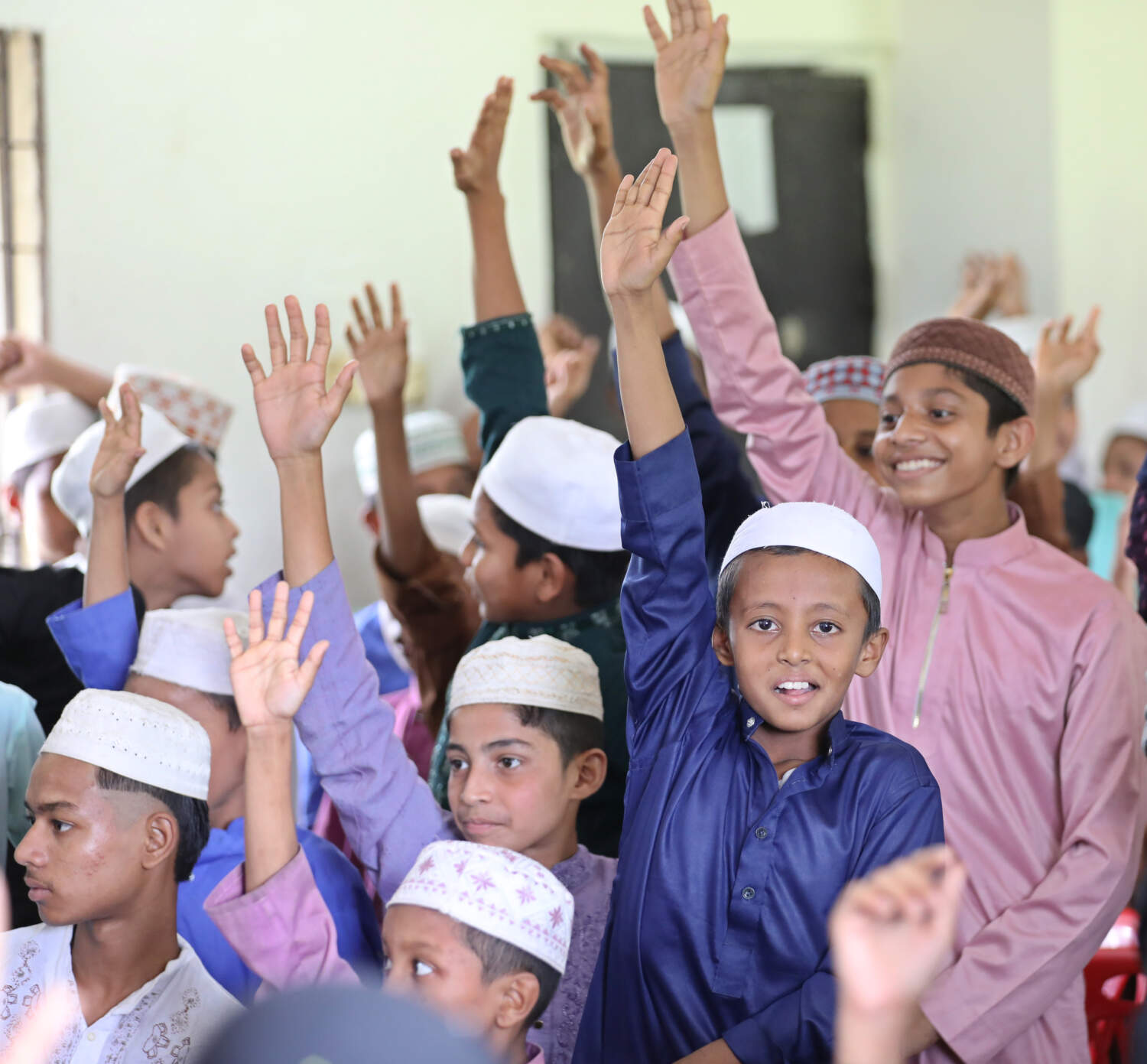
A compelling embodiment of this model is the Haj Esmat Center in Bhairab, Kishoreganj—a sanctuary of hope and resilience since 2010. Serving 650 orphans, this center is not merely a service provider; it is a living ecosystem of empowerment, education, and community-driven development. Its success is not accidental—it is the result of a meticulously designed, community-anchored model that addresses both the symptoms and root causes of vulnerability. How does this model succeed? Here are the reasons we see it as a revolution:
1. Precision in Needs Assessment
Unlike top-down models that rely on generalized surveys or distant assessments, local committees possess an unparalleled ability to diagnose community needs with surgical accuracy. Their proximity to the lived experiences of beneficiaries allows them to identify not only what is needed, but why, when, and how it should be delivered. This ensures that every intervention is contextually relevant and resource-efficient (Qatar Charity, 2025). In a sector where misaligned aid can do more harm than good, this precision is revolutionary.
2. Cost Efficiency Without Compromise
One of the most compelling outcomes of this model is its economic efficiency. By leveraging local networks and sourcing materials at near-cost prices, committees have consistently reduced project costs by at least 30% compared to conventional contractors (Qatar Charity, 2025). This is not merely a budgetary advantage—it is a paradigm shift that challenges the assumption that quality requires high expenditure. It proves that community trust and local knowledge can yield superior financial and operational outcomes.
3. Sustainability Rooted in Local Ownership
True sustainability is not achieved through one-time donations or externally managed programs—it is cultivated through local ownership and resource mobilization. From construction to maintenance, the Haj Esmat Center relies on community assets and volunteerism, transforming it from a temporary solution into a long-term investment. This model currently supports 460 resident orphans and 190 others under family care, demonstrating that sustainability is not just a goal—it is a lived reality (Qatar Charity, 2023).
4. Navigating Bureaucracy with Local Intelligence
Governmental red tape is often a major bottleneck in humanitarian work. However, local committees, with their deep understanding of administrative systems and social networks, are able to navigate bureaucratic processes with remarkable agility. This not only accelerates project timelines but also reduces the burden on central teams, freeing up resources for strategic planning and innovation.
5. Scalable Autonomy
While many organizations struggle with scaling due to centralized bottlenecks, Qatar Charity’s decentralized model allows for simultaneous implementation of dozens of projects. Each committee operates with a degree of autonomy, ensuring that growth is not only possible but also sustainable. This is not just operational efficiency—it is a blueprint for exponential impact.
6. Financial Resilience Through Trust
In traditional models, financial delays often stall progress. In contrast, local committees in Bangladesh have demonstrated extraordinary resilience by initiating work on credit, confident in Qatar Charity’s commitment to reimburse them. This mutual trust keeps projects moving forward, even in the face of logistical or financial uncertainty (Qatar Charity, 2025). It is a testament to the strength of relational capital in humanitarian ecosystems.
7. Ownership That Drives Excellence
Perhaps the most profound impact of this model is the sense of ownership it instills in communities. When people feel that a project belongs to them, their engagement transcends obligation—it becomes a source of pride and purpose. At the Haj Esmat Center, this is reflected in the 81.18% satisfaction rate among students regarding their education (Qatar Charity, 2023). Ownership is not just a motivational tool—it is a catalyst for excellence.
Tangible Impact: The Haj Esmat Center as Living Proof of a Transformative Model
The Haj Esmat Center in Bhairab, Kishoreganj, is not merely a humanitarian project—it is a living, breathing embodiment of what happens when community-driven development is executed with precision, trust, and vision. With an annual operating budget of QAR 1,480,272, the center delivers far more than basic services. It provides a holistic, future-oriented education to 650 orphans, integrating the national curriculum of Bangladesh with vocational training and spiritual enrichment. This multidimensional approach ensures that beneficiaries are not only literate but also equipped with the skills and values to thrive in a complex world.
The outcomes speak volumes. A full 100% of students report feeling safe from violence—an extraordinary achievement in a region where vulnerable children often face systemic risks (Qatar Charity, 2023). This statistic is not just a number; it reflects a carefully cultivated environment of psychological safety, emotional support, and community vigilance. Furthermore, 47.06% of the girls identified “women’s empowerment” as the most important lesson they’ve learned—an indicator that the center is not only educating minds but also reshaping mindsets and challenging generational cycles of gender inequality (Qatar Charity, 2023).
Yet, the journey is not without its complexities. Determining the appropriate scope and scale for each intervention requires continuous innovation, adaptive planning, and localized insight. But rather than being a setback, this challenge underscores our commitment to excellence. It is a reminder that meaningful change is not achieved through replication alone, but through thoughtful customization and relentless pursuit of improvement.
Strategic Recommendations: Practical Levers for Scalable, Sustainable Impact
Drawing from the success of the Haj Esmat Center and our broader operational experience in Bangladesh, we offer the following strategic recommendations for NGOs, donors, and community leaders seeking to replicate or scale this model:
- Leverage Local Wisdom from Day One
Engage local committees at the earliest stages of project design. Their insights are not supplementary—they are foundational. Without their guidance, interventions risk being misaligned with actual community needs.
- Maximize Cost Efficiency Through Local Procurement
Source materials and services locally at cost, as demonstrated by our 30% savings (Qatar Charity, 2025). This not only reduces expenses but also stimulates the local economy and builds trust.
- Invest in Continuous Teacher Development
Organize quarterly training workshops to equip educators with the tools to address the unique psychological and educational needs of orphans (Qatar Charity, 2023). A well-trained teacher is the cornerstone of quality education.
- Eliminate Financial Barriers to Access
Provide essential learning materials—books, stationery, uniforms—free of charge. This is not charity; it is a strategic investment in human capital.
- Integrate Life Skills into the Curriculum
Equip students with practical tools such as computers and sewing machines. Education must be both theoretical and applied to be transformative.
- Prioritize Infrastructure Maintenance
Address urgent repairs promptly—such as the replacement of 80 doors and 60 windows at Haj Esmat—to ensure safety and dignity in learning environments (Qatar Charity, 2023).
- Foster Community Ownership and Pride
Cultivate a sense of shared responsibility and pride in the project. When communities feel ownership, they become the most effective stewards of quality and sustainability.
- Secure Long-Term Viability Through Endowments
Diversify funding streams by establishing waqf (endowment) mechanisms. This ensures continuity even in the face of funding delays or economic shocks.
A Model Worth Sharing: From Local Success to Global Blueprint
The Haj Esmat Center is not an isolated success—it is a scalable prototype for a new era of humanitarian development. At Qatar Charity, we believe this model is not proprietary. It is a public good, a replicable framework that can be adapted by any organization, donor, or policymaker committed to maximizing impact while minimizing cost.
Imagine a world where every humanitarian initiative is rooted in local leadership, driven by data, and sustained by community pride. The Haj Esmat Center proves that this vision is not utopian—it is achievable. It breaks cycles of poverty, empowers girls to become leaders, and transforms aid from a transaction into a partnership.
So why settle for incremental change when transformational impact is within reach?
Join the Movement: Your Voice Can Ignite the Next Chapter
What are your thoughts on this community-first approach to humanitarian work? Have you witnessed or participated in similar models that sparked real change? Your insights matter. Share your experiences, ideas, or questions in the comments—or reach out directly. Your voice could be the catalyst for the next breakthrough.
Together, we can refine this model, scale its reach, and co-create a world where every child’s potential is realized and every community thrives. Don’t just observe—engage. Don’t just admire—act. Because your voice is not just an opinion—it’s a force capable of shaping futures and rewriting destinies.
References
• Evaluation and Impact Report of Haj Esmat Center, Bangladesh 2023. Dhaka, Bangladesh: Qatar Charity Bangladesh Office.
• Field Performance Report of Qatar Charity Projects in Bangladesh 2025, Qatar Charity, Doha, Qatar.