Key Takeaways from the Interview
- The future of humanitarian action is moving towards a more diversified financing system.
- Innovative financing should complement, rather than replace, public and philanthropic funding.
- Localization has yet to translate into full-scale structural change.
- In 2025, only 8.7% of direct and indirect humanitarian funding reached local and national responders, according to figures cited in the interview.
- Early action reduces humanitarian losses and enables more efficient use of resources.
- Artificial intelligence can strengthen forecasting and resource allocation, while human judgment must remain central to decision-making.
- The protection and needs of children must remain at the heart of humanitarian decision-making.
Interview by : Ali AlRachied
Humanitarian action is undergoing a period of profound change. As funding gaps widen and humanitarian needs continue to grow, calls are intensifying for greater localization, new financing models and more effective partnerships. Together, these shifts are raising fundamental questions about the future of the humanitarian sector and its capacity to respond to increasingly complex and interconnected global crises.
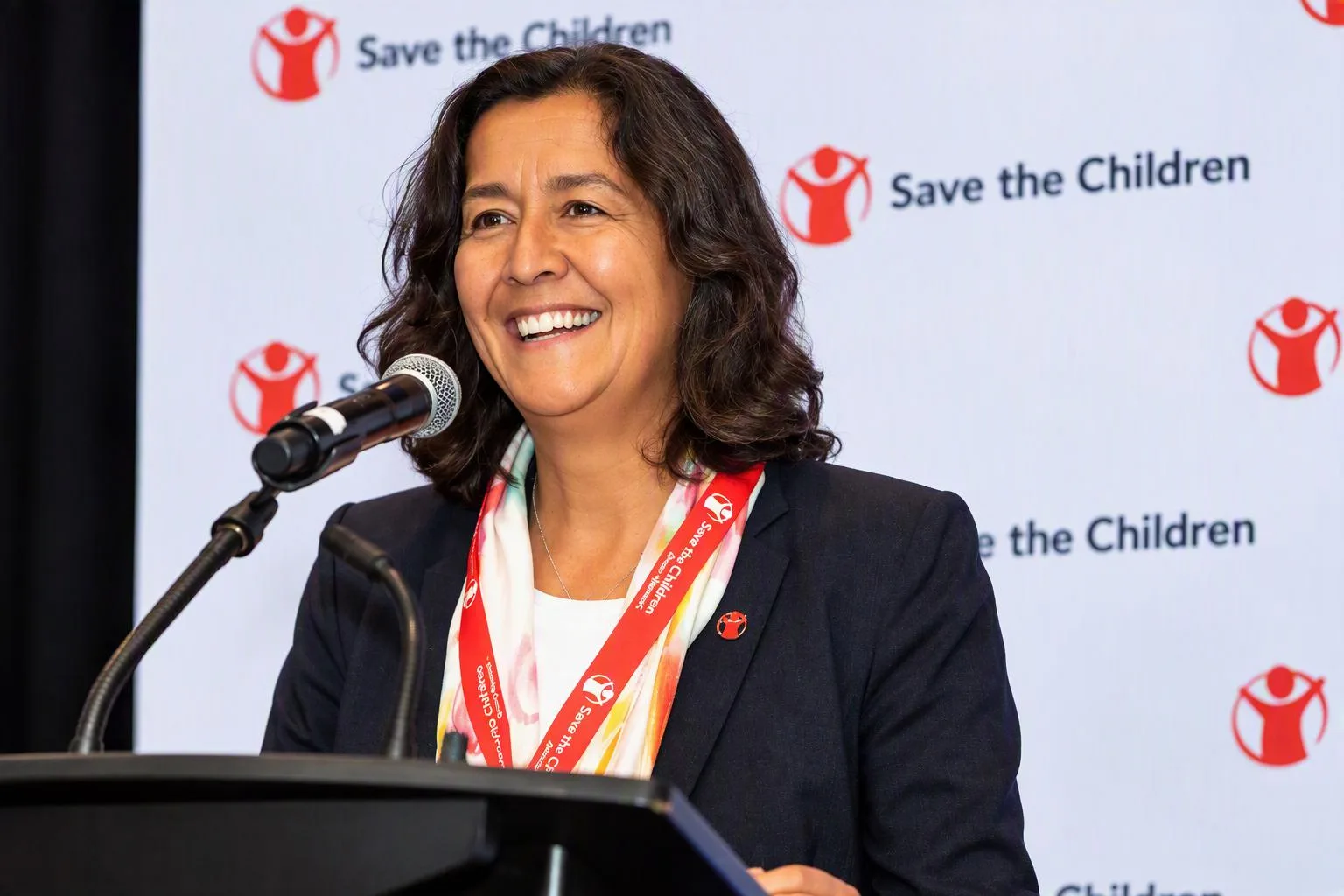
In this exclusive interview with Ghiras Magazine, Janti Soeripto, President and CEO of Save the Children US, reflects on the forces shaping the future of humanitarian action at a time of widening funding gaps and overlapping crises. She discusses innovative financing, the localization of humanitarian aid, food security, and the role of artificial intelligence in enhancing humanitarian response.
Redesigning the Global Humanitarian System
The year 2026 has seen a series of major international events, from the World Bank and IMF Meetings to the Global Partnerships Conference in London, all reflecting a growing shift toward new models of financing, partnerships, and locally led development. How do you interpret these developments? Are we witnessing a redefinition of the role of global humanitarian action in the years ahead?
Yes, but I would frame it less as a new shift and more as a long-overdue redesign of how humanitarian action works.
The ideas dominating today’s discussions, whether around localization, innovative finance, or new partnerships, are not new. The sector has been talking about them for years. What is different now is that growing humanitarian needs and tightening resources are forcing us to move from conversation to implementation—and more quickly. We can no longer afford to preserve the status quo.
That starts with rethinking aid as an investment in shared resilience and global stability, not simply assistance flowing from one part of the world to another. It means moving decision-making and resources closer to communities, giving local actors a much stronger role in defining problems and shaping solutions. It also means international organizations must change the way we work: building a more effective system, collaborating more deeply and embracing new models that reduce duplication and increase impact.
Finally, humanitarian action must become more anticipatory and preventative. We know that acting early saves lives, reduces suffering, and lowers costs. Investing in preparedness, local capacity, and flexible funding allows us to respond before crises escalate.
The mission itself has not changed. Our responsibility remains ensuring that children are healthy, educated and protected. What is changing is the system we build around that mission, including how we partner and build sustainability into our work.
The Future of Humanitarian Financing and Innovative Finance
This year has also seen increasing discussion around the transition from traditional aid models toward blended finance, social investment, and the mobilization of private capital, alongside a widening humanitarian funding gap. In your view, does this represent a fundamental shift in the philosophy of humanitarian action and its financing? What are the most significant opportunities and risks associated with this transition?
We are seeing a significant shift in financing, driven by necessity but also by opportunity. Public aid budgets are under pressure while humanitarian needs continue to rise.
I don’t see private capital replacing traditional humanitarian finance. Rather, we’re moving toward a more diversified and resilient funding ecosystem where public funding, philanthropy, impact investment, and private capital all play a role.
At Save the Children, we’re accelerating that transition by expanding private-sector and philanthropic support, exploring innovative financing through our global impact investing arm, Save the Children Global Ventures, and pursuing emerging opportunities such as our Bitcoin Fund.
The opportunity is not just more funding. There is far more capital, expertise, technology, and innovation available in the world than is currently being directed toward solving humanitarian challenges. If we can mobilize those capabilities, we can scale effective solutions and not only save lives but also change them sustainably.
But the goal is not to pursue new sources of capital for their own sake. The measure of success is whether they help us reach children faster, more effectively, and with greater impact.
Children’s needs cannot be determined by what generates a financial return.
There is also a clear red line: Children’s needs cannot be determined by what generates a financial return. Humanitarian principles and evidence of need must continue to guide where and how we act.
So I see this as an expansion of the financing toolbox, not a privatization of humanitarian action. Public finance and philanthropy remain essential, while innovative finance can help unlock additional resources and capabilities where they can create the greatest impact.
Interconnected Crises and Humanitarian Response
How can the humanitarian sector respond effectively to the reality of “polycrises,” where conflicts, climate change, food insecurity, energy challenges, and global economic pressures are increasingly interconnected and unfolding simultaneously?
The reality of “Polycrises” is not going away. We live in an interconnected world—the supply chain crisis caused by this year’s complex conflict in the Middle East was a reminder that violence in one part of the world can affect food prices and humanitarian supplies urgently needed in other countries.
We are also in an era in which conflicts last longer and unprecedented environmental disasters are occurring with higher frequency —such as the August 2026 flash floods in Nepal and the ongoing Super El Niño.
Foreign aid has retreated as humanitarian needs are increasing. And children are most at risk. A crisis, especially a prolonged, complex, or repeated one, can rob a child of nutrition, safety, and education in critical development years. First of all, we need definitive and lasting ceasefires in reality, not just on paper. From private and public donors, we need flexible investment in response and recovery so that we can address compounded needs in totality, not as unrelated problems. Simultaneously, humanitarian actors will save funds and human suffering by implementing early and anticipatory action for emergencies. The sooner we act on knowledge of disaster, the more we can mitigate damages and the more cost-effective those responses are. We must invest in resilient communities and an international community.
The Humanitarian Funding Gap and Shrinking Resources
At a time when humanitarian needs continue to rise worldwide while available resources remain constrained, what do you see as the most significant implications for the world’s most vulnerable populations in the coming years?
The most immediate risk is that vulnerable populations, particularly children, will face increasingly difficult choices between essential needs.
When resources become constrained, families may delay healthcare, withdraw children from school, reduce food consumption, or resort to negative coping strategies simply to survive. We know from experience that the impacts of those decisions can last for years and sometimes generations.
I am particularly concerned about the long-term consequences. A child who is malnourished today is more vulnerable to illness tomorrow. A child who misses school for an extended period may never fully return to education. These losses compound over time.
My greatest concern is that we begin to reverse hard-won progress for children. Over the past decades, the world has made remarkable gains in child survival, nutrition, education, and health. Those gains should not be taken for granted. If current trends continue, we risk leaving a generation of children behind and widening the gap between those who can access essential services and opportunities and those who cannot.
When children are excluded from healthcare, nutrition, protection, and learning, the effects are felt for decades in the stability, prosperity, and resilience of entire communities and countries. The cost of that failure will not be measured only in funding gaps. It will be measured in children’s lives, futures, and potential.
The Future of Global Food Security
The world is facing mounting food security challenges, with growing numbers of people at risk of hunger and malnutrition. How do you assess the future of global food security, and what urgent priorities should be addressed to prevent the situation from deteriorating further?
Food security is one of the defining challenges of our time because it sits at the intersection of conflict, climate change, economic instability, and public health.
We know how to prevent and treat severe malnutrition. We know how to build more resilient food systems. We know that investing in maternal and child nutrition delivers some of the highest returns. The challenge is not a lack of knowledge or solutions; it is whether we are willing to act with sufficient urgency and scale.
Children must remain at the center of the response. Malnutrition in early childhood has lifelong consequences for growth, learning, and health. Preventing malnutrition is not only a humanitarian imperative; it is one of the smartest investments societies can make.
Looking ahead, we need to move beyond responding to hunger and invest more in preventing it. That means strengthening local food systems, building resilience to climate shocks, supporting frontline health services, and acting earlier before food crises become humanitarian emergencies.
The world produces enough food. The question is whether we have the commitment to ensure every child can access the nutrition they need to survive and thrive.
Localizing Humanitarian Action and Financing Local Actors
After years of calls for humanitarian localization and the transfer of leadership to local actors, how much meaningful progress has been achieved in practice? What are the main challenges that continue to hinder this transformation?
Ten years since the Grand Bargain’s inception in 2016, there are some real bright spots of progress towards the localization of humanitarian assistance. In places like Nigeria, Somalia, South Sudan, Yemen, and beyond, we have seen concerted efforts elevate the leadership and voices of local actors in humanitarian coordination mechanisms. Save the Children has been part of this process through projects such as the capacity building of local and national non-governmental organizations (LNNGOs) in Nigeria, Somalia, and South Sudan,
The world produces enough food. The question is whether we have the commitment to ensure every child can access the nutrition they need to survive and thrive.
However, progress remains moderate and at the peripheries, falling short of meaningful and structural change: In 2025, Grand Bargain signatories reported only 8.7% of both direct and indirect humanitarian funding reaching local and national responders – well short of the 25% target set in 2016. And globally, only 3.8% of humanitarian funding directly reached local and national responders last year.
A multitude of challenges stand in the way of transformational progress:
- There remains limited accountability
- Funding cuts are creating more competition, pushing many international organizations into the domestic markets local responders traditionally rely on.
- Funding rules make it harder for local organizations to get support, creating barriers and hindering efforts to reach those in need.
- Decisions are often made far away from affected communities.
- Local voices and influence remain largely absent from international humanitarian policy and decision-making.
Action is needed now more than ever. While increased recognition of and commitment to the role and leadership of local responders is promising, commitments must be followed with meaningful action if the sector is going to truly realize localization as a standard at scale.
Artificial Intelligence and Technology in Humanitarian Action
The humanitarian sector is increasingly embracing technology and artificial intelligence. How can these tools be leveraged to improve the effectiveness and efficiency of humanitarian response while ensuring adherence to humanitarian principles and ethical standards?
Technology and artificial intelligence have significant potential to improve humanitarian outcomes. We are already seeing opportunities to strengthen forecasting, identify emerging risks, improve operational efficiency, and make better use of data. Used well, these tools can help organizations allocate scarce resources more effectively and respond more rapidly to evolving needs.
However, we should view technology as an enabler, not a solution in itself. Humanitarian action is fundamentally about people. Decisions that affect vulnerable populations should always be guided by human judgment, accountability, and ethical considerations.
As the sector adopts AI and other advanced technologies, we must ensure that transparency, privacy, equity, and protection remain central, especially in places that are affected by conflict or displacement. The goal should be to augment human expertise, not replace it.
Humanitarian Action in the Decade Ahead
Looking ahead, what are the most significant changes you expect to shape global humanitarian action over the next decade? And what should be done today to ensure that humanitarian needs remain at the forefront?
I expect the next decade will be shaped by three major trends: more fragility greater ownership and sovereignty from local actors and governments, and much deeper use of technology and data.
At the same time, I believe humanitarian organizations will be under increasing pressure to demonstrate effectiveness, efficiency, and measurable impact. This is a good thing. It can drive innovation, encourage collaboration, and help ensure that more resources reach the people who need them most.
What must not change is our commitment to the people at the center of these crises. Children facing hunger, conflict, displacement, and hardship cannot become secondary considerations in global debates about budgets, politics, or institutional reform.
I remain optimistic because history shows that progress is possible. The world has dramatically reduced child mortality, extreme hardship, and many preventable diseases over recent decades. Those achievements demonstrate what is possible when governments, civil society, communities, philanthropists, and businesses work together toward a common goal.
The world has never had more science, technology and resources at its disposal to solve and eradicate problems for children; now is not the time to just defend. It is time to be unashamedly ambitious and push for these goals. Children deserve nothing less.
Who Is Janti Soeripto?
Janti Soeripto has served as President and CEO of Save the Children US since 2020, leading one of the world’s foremost humanitarian organizations dedicated to protecting children and providing access to education and health care in the United States and around the world. She holds master’s degrees in economics and finance and graduated from Erasmus University Rotterdam in 1991.
Soeripto is a prominent voice in humanitarian diplomacy, regularly representing the organization at the United Nations, the World Bank, and the World Economic Forum. She is also a strong advocate for the protection of children and for ensuring the delivery of urgent humanitarian assistance in major conflict settings, including Gaza, Sudan, Afghanistan, and Ukraine.