in the Rohingya Refugee Camps
By Tanvir Elahi, Bangladesh
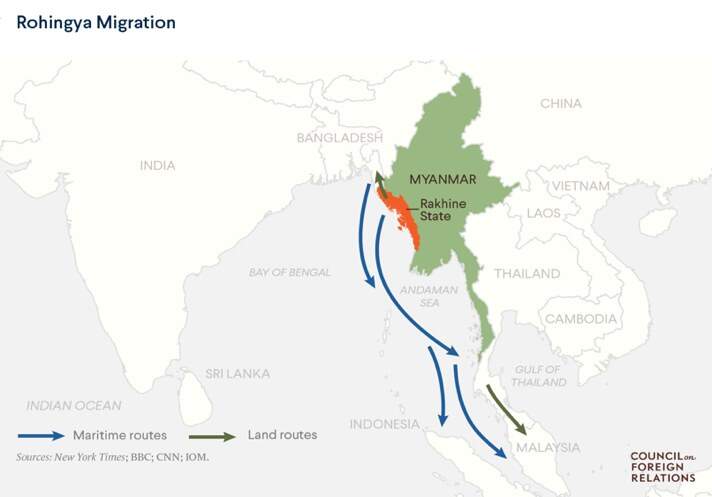
The term Rohingya is commonly used to refer to a community of Muslims generally concentrated in Rakhine (Arakan) state in Myanmar (Burma), although they can also be found in other parts of the country as well as in refugee camps in neighboring Bangladesh and other countries. They are considered to be among the most persecuted minorities in the world.
Fig 01: Rohingya migration; Source: Council on Foreign Relations, 2023.
The Rohingya community has faced prolonged persecution and violence in Myanmar, leading to repeated waves of forced displacement into Bangladesh following major influxes in 2016, 2017, and 2024. According to data published by the United Nations High Commissioner for Refugees (UNHCR) on 31 March 2026, approximately 1,189,213 Rohingya refugees are currently living in Cox’s Bazar and Bhasan Char, with children representing nearly 45 percent of the population. Among them, 3,534 children have been identified as unaccompanied and separated children (UASC). In addition, according to the Ministry of Disaster Management and Relief (MoDMR) and the Refugee Relief and Repatriation Commissioner (RRRC) (August 2024), 43,997 children are identified as orphans.
The ongoing humanitarian crisis has resulted in the establishment of the world’s largest refugee settlement in Cox’s Bazar, where women and children constitute around 78 percent of the refugee population, highlighting their heightened vulnerability and protection needs.
Unaccompanied and Separated Children
Unaccompanied and separated children are among the most vulnerable groups in this crisis. They are at heightened risk of trafficking, abuse, and exploitation. Girls are of particular concern due to their increased exposure to abuse, violence, sexual exploitation, and neglect.
A comprehensive study conducted by UNICEF and the Child Protection Sub-Sector in October 2021 highlighted the critical child protection concerns within the camps. The findings revealed that 64% of respondents identified child labour as a significant issue, while neglect was reported by 59%. Additionally, 57% of respondents highlighted child marriage as a prevalent problem, and 32% pointed to the risks of trafficking. Other concerning issues included depression among children (27%), separation from families (25%), and physical abuse (23%). These figures paint a grim picture of the challenges faced by Rohingya children in the camps.
Current Alternative Care Management for UASC
The majority of unaccompanied and separated children (UASC) in the Rohingya refugee camps are placed in foster care, kinship care, or temporary residential care arrangements. Institutional care options for UASC within the camps are notably limited.
When the Rohingya refugee crisis began, the number of UASC cases in Cox’s Bazar was alarmingly high. These children are among the most vulnerable populations in the camps, facing heightened risks of human trafficking, gender-based violence (GBV), and exploitative child labour. Child protection agencies follow the family tracing renunciation (FTR) and SOP to identify these children and connect them with appropriate caregivers.
Despite these efforts, challenges persist in ensuring consistent and adequate care for UASC. The limited capacity of institutional care facilities and the dependence on foster and kinship care underscore the need for more robust support systems. Strengthening the resource base of NGOs operating in the camps and enhancing coordination among stakeholders are essential to address the gaps in alternative care management. By prioritizing the protection and care of UASC, humanitarian agencies can mitigate the risks faced by these vulnerable children and provide them with a stable environment for recovery and growth.
Recommendation
The Government of Bangladesh, together with national and international organizations and the Department of Social Services, continues to support displaced Rohingya populations, including unaccompanied and separated children (UASC). To strengthen the response, several strategic recommendations are proposed.
Integrated and long-term programmes for UASC can be enhanced through stronger coordination mechanisms and dedicated technical working groups among humanitarian and government actors. Humanitarian assistance may be expanded by diversifying food support, extending seasonal assistance, and providing needs-based support to caregivers and foster families. Caregivers require regular training on child protection, safeguarding, psychosocial support, and positive parenting practices to improve the quality of care for UASC. In addition, an automated case management and tracking system with standardized operating procedures (SOPs) may strengthen accountability, referral pathways, documentation, and follow-up services.
Community-based support centres within the camps can provide integrated services for UASC, caregivers, and youth groups. These centres may function as child-friendly spaces, psychosocial support hubs, livelihood and vocational training centres, and technology transfer facilities with market linkage support.
Finally, further research remains essential to understand better the evolving needs of UASC, including those of those who have been displaced for eight years and recent arrivals. Studies exploring culturally appropriate alternative care approaches, including kafala within the Islamic framework, may contribute to more sustainable and community-accepted child protection solutions.