Book Details
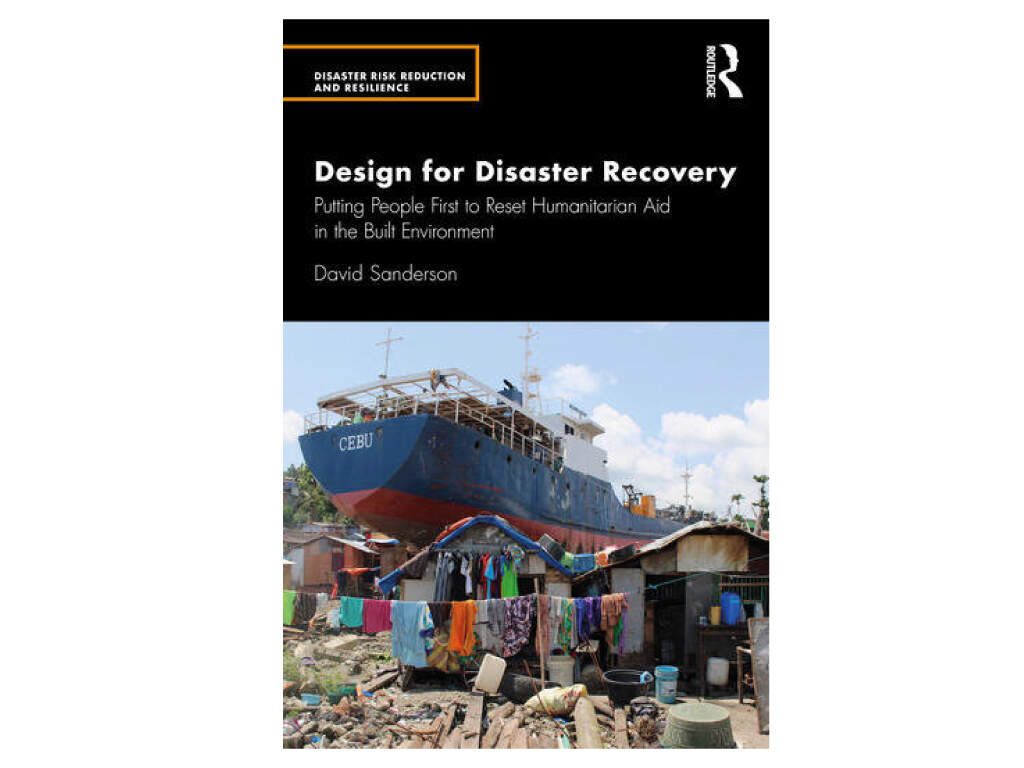
Title: Design for Disaster Recovery: Putting People First to Reset Humanitarian Aid in the Built Environment
Author: David Sanderson
Publisher: Routledge
Publication year: 2026
Rethinking Recovery
How can humanitarian assistance support disaster recovery without displacing people’s ability to make decisions about their own lives?
This question lies at the heart of the book’s argument. In the context of escalating urban disasters and reduced aid budgets, David Sanderson advocates responses that prioritize people’s agency and strengthen local organizations. Drawing on experiences in urban development, he explores alternatives to established top-down practices.
Lessons from Development
The book’s seven chapters connect urban disasters and humanitarian reform with participatory development, sustainable livelihoods, and post-disaster shelter. Its discussion of low-income urban housing introduces approaches to planning that recognize residents’ knowledge, resources, and capacity to shape their surroundings.
A chapter on people-centered approaches addresses barriers to listening to communities and examines how success is measured, contrasting efficiency with effectiveness. It also considers basic needs, assets, access to resources, and discrimination in relation to building capacity and reducing vulnerability.
Beyond Rebuilding Structures
Shelter provision receives particular attention, from temporary accommodation to permanent housing and settlements. The relevant chapter includes discussions of architectural proposals, design competitions, and their translation into practice, alongside an example of permanent housing provision following the 2001 earthquake in Gujarat.
The closing chapter proposes three ways for aid organizations to relinquish greater control: expanding area-based approaches, using cash-based programming to support people’s agency, and making use of unexpected opportunities. These proposals reinforce the book’s emphasis on recovery as a process requiring engagement and trust, rather than simply the delivery of physical structures.
Expert Endorsements
Kamal Kishore, the UN Secretary-General’s Special Representative for Disaster Risk Reduction, commends the book’s practical guidance for breaking recurring cycles of disaster and recovery, drawing on development principles to strengthen community-led recovery.
Ian Davis, described by the publisher as a visiting professor at Kyoto, Lund, and Oxford Brookes universities, praises its practical advice and people-centered approach to low-income urban housing. He also highlights its emphasis on humility among officials supporting disaster-affected communities.
About the Author
David Sanderson trained as an architect and has more than 30 years of international experience in development and disasters. His career includes policy and regional leadership roles with CARE International UK and a visiting professorship at Harvard University’s Graduate School of Design between 2013 and 2014.